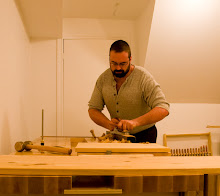
I have a dirty little secret that woodworking videos put me to sleep. I have to watch them a few times to get all of the information in between naps. I love them, and keep buying them, but they put me out.
My all-time favourite cure for insomnia had been Rob Cosman's "Rough to Ready" wherein we get to spend an hour watching him plane one board. Little did I know that I hadn't seen anything yet.
I bought the video "Sharpening Woodturning Tools" by Mike Darlow. Oh boy.
First let me say that there is excellent information in there. His is the very first woodworking-oriented sharpening... thing... that mentions that you should never quench high-speed steel. This is something that machinists and metallurgists have known for almost 100 years, but woodworkers who use a bench grinder seem to be addicted to dunking their tools in water every 10 seconds as they're grinding them. You should never do this to high-speed steel as it will develop micro-cracks and you'll be just begging for a future fracture. Feel free to quench your regular carbon steel, but never quench HSS. Anyway, lots of info. TONS of info. Almost THREE HOURS of info. It's going to take me a week to see it all, between naps, but I'm glad I bought it. It covers every jig I've ever heard of, and sharpening every common lathe tool, though not hook tools or other esoterics... at least, not that I've been awake for so far. :)
The production quality is not professional, but it gets the point across.
Showing posts with label sharpening. Show all posts
Showing posts with label sharpening. Show all posts
Wednesday, November 5, 2008

Monday, October 20, 2008
New Life for an Old Saw
I have an old Crown Gent's Saw that I bought new a long time ago (15-20 years) and never liked. It's got far too much set, won't follow a line, and basically cuts terribly. When I got it I had no idea how to fix up a crappy saw, so I threw it into a box and forgot about it. I found it a while back, but now I have good saws that I love so I had no intention of putting any effort into this saw. It could stay in the box.
Recently a thread started on the Canadian Woodworking forum that included the notion of refurbishing a Crown Gent's Saw. A suggestion that I made was not taken gladly by some, so I've decided that I will refurbish my own elderly Crown Gent's Saw in the interest of proving the point that the method works.
First, the saw. Here it is in its crappy glory.
It will be refurbished into a dovetail saw, so for that it will need a rip-pattern tooth form, and it needs to have its set radically reduced. First, reduce the set. Take a pair of hardwood blocks and lay the saw between them. With raps of a hammer you can squeeze the teeth together to reduce the set. Depending on the size of your blocks, it can take a surprisingly hard hit. Below is the setup that I used for reducing the set. A chunk of red oak (would have preferred something harder) with another piece of red oak as a 'punch'.

Once the set was reduced it was time to file. I put the sad saw in the saw vise and got out my smallest saw file - brand-spanking-new. Only the best for the crappy old Crown Gent's Saw. :)

Now to file it to a rip cut. First I ran a mill file over the top to joint the saw. Not that I expected the jointing to be off... this saw had never been sharpened (or used, really) so the teeth should be in factory condition, but by taking a light jointing pass I can more easily see where I am in the filing process. After filing the saw I tried it out. I had done two test kerfs in a piece of white pine before starting on refurbishing the saw. The test board can be seen below. The two 'before' kerfs are each the result of 50 strokes of the saw. The 'after' kerf is the result of only 12 strokes of the saw, and I had to stop because the spine had hit the top of the board and I could go no deeper. The saw now cuts fast and straight, and all for about 20 minutes of effort. If I had it to do over again I would have done some more beating on the wooden blocks to reduce the set even more. The last kerf in the test board is from my Medallion dovetail saw. Only 8 strokes. Nice. Much longer saw, though, so it has a bit of an advantage, there.

Anyway, that was my refurbishing of a Crown Gent's Saw. It's not hard, so if you have one that you hate then have a go at fixing it up.
Recently a thread started on the Canadian Woodworking forum that included the notion of refurbishing a Crown Gent's Saw. A suggestion that I made was not taken gladly by some, so I've decided that I will refurbish my own elderly Crown Gent's Saw in the interest of proving the point that the method works.
First, the saw. Here it is in its crappy glory.

It will be refurbished into a dovetail saw, so for that it will need a rip-pattern tooth form, and it needs to have its set radically reduced. First, reduce the set. Take a pair of hardwood blocks and lay the saw between them. With raps of a hammer you can squeeze the teeth together to reduce the set. Depending on the size of your blocks, it can take a surprisingly hard hit. Below is the setup that I used for reducing the set. A chunk of red oak (would have preferred something harder) with another piece of red oak as a 'punch'.

Once the set was reduced it was time to file. I put the sad saw in the saw vise and got out my smallest saw file - brand-spanking-new. Only the best for the crappy old Crown Gent's Saw. :)

Now to file it to a rip cut. First I ran a mill file over the top to joint the saw. Not that I expected the jointing to be off... this saw had never been sharpened (or used, really) so the teeth should be in factory condition, but by taking a light jointing pass I can more easily see where I am in the filing process. After filing the saw I tried it out. I had done two test kerfs in a piece of white pine before starting on refurbishing the saw. The test board can be seen below. The two 'before' kerfs are each the result of 50 strokes of the saw. The 'after' kerf is the result of only 12 strokes of the saw, and I had to stop because the spine had hit the top of the board and I could go no deeper. The saw now cuts fast and straight, and all for about 20 minutes of effort. If I had it to do over again I would have done some more beating on the wooden blocks to reduce the set even more. The last kerf in the test board is from my Medallion dovetail saw. Only 8 strokes. Nice. Much longer saw, though, so it has a bit of an advantage, there.

Anyway, that was my refurbishing of a Crown Gent's Saw. It's not hard, so if you have one that you hate then have a go at fixing it up.
Sunday, September 7, 2008
Sharpening. What works for me.
Sharpening blades is a metalworking activity, and metalworking is what I do, and what I'm used to. At first I automatically gravitated towards diamond stones, because that's what I'm used to. I've got a diamond hone that I've had bouncing around in my toolbox for over a decade. Maybe 15 years, now. Still works great.
So when I got into woodworking I bought diamond stones, and used them, and liked them.
Then I needed something finer, so I bought ceramic stones. Again - something I was used to. I didn't want oil stones (which I'm also used to) because of the mess.
Eventually I got tired of hearing about how great water stones are and how they are the One True Path for sharpening, so I bought a few to try them out.
The following is about what I have, and what I actually use.
Firstly, here are my diamond stones. The small one is a roughing stone, 250 grit, 6"x2". It is rarely used.. it's only needed to fix a chip in a chisel or something like that. The larger stone is double-sided with 600 grit on one face and 1200 grit on the other. This is still my most-used stone, and if I had to have just one this would be THE ONE. These are DMT stones with the drilled sharpening plate, obviously. I like these a lot for plane irons and chisels because the swarf (that's the 'metal dust' that is abraded from the object being sharpened) falls into the 'holes' and doesn't cause scratches in the finish. These are not great for small gouges or small knives or anything else that will poke into the holes and get maimed. For that you want a flat, undrilled plate, which DMT makes as well.
Next comes my first polishing stone. This is a ceramic stone.
I like ceramic stones a lot because they cut fast, and will happily do the job with just a touch of lubricant, which can be anything handy. I use mineral spirits as the lubricant for both the diamond stones and the ceramic stones, because it evaporates and won't cause rust.
Here are the water stones. I've got two 1000 grit Nortons, plus an 8000 grit Norton. The reason I got two 1000 grit stones is so I could use Rob Cosman's method of keeping the stones flat. It works.
And here is my current sharpening jig which I use when grinding the bevel. I do honing by hand, and I'll get to that in a minute, but I like the jig for getting the angle right on the bevel. I use the Veritas Mark II, and I have the cambered roller for lightly cambered blades (smoothing planes).
So what do I actually use? Good question. At first I used the jig on the diamond stones and was happy. The blades weren't really sharp enough at only 1200 grit, but most of the time it was actually just fine. When I needed more sharpness I bought the ceramic 8000 grit stone. It's too small to easily use with the jig, but I used it anyway and it worked.
When I heard the siren call of the water stones I pulled out the VISA card and bought them, took them home, and spent a weekend sharpening everything I owned. At first I liked them. I really did. If you're going to do a serious hours-long sharpening session, they work great. For touch-ups they suck. Why? Mud. They get mud all over everything. It's horrible. And if that wasn't bad enough, I found spots of rust on some of my blades the next day, and also on the bedding surfaces of the planes. I thought I'd wiped them off well enough, but I guess I hadn't. That wasn't a good morning for me. I wasn't happy at all.
At one point I considered using just the 8000 grit water stone, because it doesn't need to be soaked, just spritzed with water. I could use a diamond stone to keep it flat, and just leave the 1000 grit stones in the cupboard. Then I got wise.
I got myself a 'secret weapon'. Yes! Cast a loving eye on this beauty!
What? You expected high-tech? From the hand-tool-only guy? Nope. An elderly Craftsman hand-cranked grinder with a hard felt wheel charged with the green honing compound that Lee Valley sells. Oh, it's... it's just magical. I can take a chisel from the 1200 grit diamond stone, give it a quick hone on the hand grinder, and it is shaving-sharp. I mean, the unwary could shave clear down to the bone in a heartbeat. It's wicked sharp. So once in a blue moon I use the non-rusting-mineral-spirits-lubricated diamond stones with the jig to establish my angles, then I just buff the tool as required on the wheel. No need to remove the wire edge, either... it just 'vanishes'. When it's gone, you're done. You don't touch the back of the blade, you just hone the bevel. This thing works gangbusters for carving knives and whatnot.
Of course, 19 times out of 20 you just need to touch the edge to the wheel again to re-hone it. Re-grinding the bevel is a rare occurrence around here.
I'm considering making a grinder (yes, a powered one) that would have easily replacable wheels so that I could have different firmnesses of felt, or a buffing wheel, or different profiles (for gouges, etc.). I'm still mulling over the design.
So when I got into woodworking I bought diamond stones, and used them, and liked them.
Then I needed something finer, so I bought ceramic stones. Again - something I was used to. I didn't want oil stones (which I'm also used to) because of the mess.
Eventually I got tired of hearing about how great water stones are and how they are the One True Path for sharpening, so I bought a few to try them out.
The following is about what I have, and what I actually use.
Firstly, here are my diamond stones. The small one is a roughing stone, 250 grit,
 6"x2". It is rarely used.. it's only needed to fix a chip in a chisel or something like that. The larger stone is double-sided with 600 grit on one face and 1200 grit on the other. This is still my most-used stone, and if I had to have just one this would be THE ONE. These are DMT stones with the drilled sharpening plate, obviously. I like these a lot for plane irons and chisels because the swarf (that's the 'metal dust' that is abraded from the object being sharpened) falls into the 'holes' and doesn't cause scratches in the finish. These are not great for small gouges or small knives or anything else that will poke into the holes and get maimed. For that you want a flat, undrilled plate, which DMT makes as well.
 Next comes my first polishing stone. This is a ceramic stone.

I like ceramic stones a lot because they cut fast, and will happily do the job with just a touch of lubricant, which can be anything handy. I use mineral spirits as the lubricant for both the diamond stones and the ceramic stones, because it evaporates and won't cause rust.
Here are the water stones. I've got two 1000 grit Nortons, plus an 8000
 grit Norton. The reason I got two 1000 grit stones is so I could use Rob Cosman's method of keeping the stones flat. It works.
And here is my current sharpening jig which I use when grinding the bevel. I do
 honing by hand, and I'll get to that in a minute, but I like the jig for getting the angle right on the bevel. I use the Veritas Mark II, and I have the cambered roller for lightly cambered blades (smoothing planes).
So what do I actually use? Good question. At first I used the jig on the diamond stones and was happy. The blades weren't really sharp enough at only 1200 grit, but most of the time it was actually just fine. When I needed more sharpness I bought the ceramic 8000 grit stone. It's too small to easily use with the jig, but I used it anyway and it worked.
When I heard the siren call of the water stones I pulled out the VISA card and bought them, took them home, and spent a weekend sharpening everything I owned. At first I liked them. I really did. If you're going to do a serious hours-long sharpening session, they work great. For touch-ups they suck. Why? Mud. They get mud all over everything. It's horrible. And if that wasn't bad enough, I found spots of rust on some of my blades the next day, and also on the bedding surfaces of the planes. I thought I'd wiped them off well enough, but I guess I hadn't. That wasn't a good morning for me. I wasn't happy at all.
At one point I considered using just the 8000 grit water stone, because it doesn't need to be soaked, just spritzed with water. I could use a diamond stone to keep it flat, and just leave the 1000 grit stones in the cupboard. Then I got wise.

I got myself a 'secret weapon'. Yes! Cast a loving eye on this beauty!
What? You expected high-tech? From the hand-tool-only guy? Nope. An elderly Craftsman hand-cranked grinder with a hard felt wheel charged with the green honing compound that Lee Valley sells. Oh, it's... it's just magical. I can take a chisel from the 1200 grit diamond stone, give it a quick hone on the hand grinder, and it is shaving-sharp. I mean, the unwary could shave clear down to the bone in a heartbeat. It's wicked sharp. So once in a blue moon I use the non-rusting-mineral-spirits-lubricated diamond stones with the jig to establish my angles, then I just buff the tool as required on the wheel. No need to remove the wire edge, either... it just 'vanishes'. When it's gone, you're done. You don't touch the back of the blade, you just hone the bevel. This thing works gangbusters for carving knives and whatnot.
Of course, 19 times out of 20 you just need to touch the edge to the wheel again to re-hone it. Re-grinding the bevel is a rare occurrence around here.
I'm considering making a grinder (yes, a powered one) that would have easily replacable wheels so that I could have different firmnesses of felt, or a buffing wheel, or different profiles (for gouges, etc.). I'm still mulling over the design.
Subscribe to:
Posts (Atom)